
A conversation with Gaëlly KELE-MFOUNOU, dietician at ES-KO Congo
Out on remote oil rigs, far from home and the people they love, a meal is never just a meal. It's a moment of comfort, a reminder that someone cares. For ten years, Gaëlly KELE-MFOUNOU has crossed the water to reach these crews — turning what's on their plates into wellness practices, reminding residents someone is looking out for them.
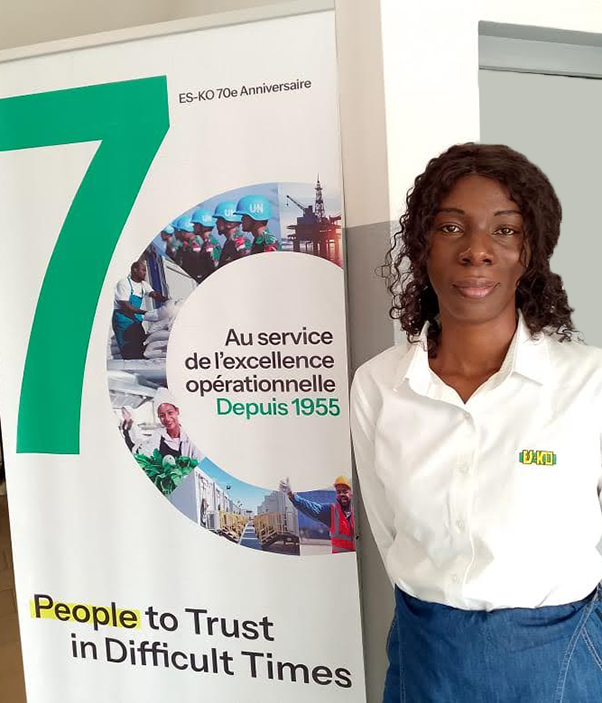
Could you tell us a little about yourself and your role at ES-KO?
I'm a dietician and a food-industries engineer. But the way I see it, my work is really about people. It starts with the diners — the ones who live and work on our oil sites — and reaches the company through them. What we bring is a link that's easy to lose sight of out there: the one between what you eat and how you feel. In practice, that means talking nutrition with the residents, training the cooks in how they prepare and balance a meal, and working with the Campbosses to build menus that get the protein, vegetables and starches right. Every month we choose a theme — reining in sugar and salt, cooking food so it actually does you good — and we build everything around it.
So you tour all the onshore and offshore sites several times a year?
Exactly. On some sites it's written into the contract: twice a month. I come at the start of the month to train teams on a nutrition theme, then come back at the end to see whether it took hold. Then I hand the client a summary drawn from the month's consumption, showing where the site is trending: sugar, salt, fruit and vegetables, dairy.
Many of the diners live on isolated platforms. How does nutrition shape their well-being?
At the beginning, nutrition had no place in oil & gas meals, and honestly, people saw no reason for it. Once you're cut off from everything, the work is all that's left, and food becomes a comfort, a way to fill the distance. But over the years, the clients started to see something troubling: chronic illness creeping across their sites. People were being evacuated — not from accidents, but from things that never should have gone that far. Diabetes. Hypertension. Obesity. That's when it became impossible to ignore. Eating well isn't about taking as much as you want; it's about knowing what your body needs, and how. And the best part is that so many residents take the new healthy habits home now, to their own families.
When it comes to eating, what are the most common mistakes?
The first one isn't really a mistake — people simply arrive with their culture, and there's something beautiful in that. Someone from an Asian background will taste a bit of everything, mixing sweet and salty without a second thought. On a multicultural site with Romanians, Poles, French and Americans all together, the plate is shaped by how each person grew up. The Italian who finds his lasagna waiting will say he “ate very well” — not because it was balanced, but because for a moment, it tasted like home. Then come the misconceptions: that tomato sauce counts as a vegetable, or that rice makes you gain weight. Behind every one of them, we plant a little awareness and instead of reaching one person, the message travels to many more.
We all know the benefits of exercise, but on offshore sites, how do you get people moving?
At our biggest clients, the oil rigs now have lounges and real gyms, properly equipped. And yet they remain almost empty. So I never talk about food on its own — I tie it to movement, always. Eating well isn't enough by itself; you have to exercise. And going to the gym without knowing how to feed yourself won't get you there either. What I want is for this to become second nature, the two things inseparable, and everyone can take advantage of the sports equipment, because it's all right there, and it's free.
Is there any tracking of weight and exercise, or is it mainly advice?
We don't force a rhythm on anyone, but we follow a clear calendar. July into August, for instance, we throw ourselves into fitness alongside every site manager. On July 16, at one site, I gathered 65 people. We ran an awareness session, and I appointed “sports ambassadors”, whose mission is to motivate the others to go to the gym. At the end of August, I’ll come back to see if the spark stayed lit. When a site opens itself to the idea, it spreads beautifully; some clients even come to me with themes of their own.
Do you run other formats too — nutrition themed days, activities, competitions?
Yes. After every wellness campaign, we leave posters all through the mess hall so the message lingers, and every two months we bring in a new theme. The real strength is that it's shared: when we take on a nutrition theme, every site speaks the same language and carries the same message. And I slip in little games — guess the food, answer a quiz— so it never feels like a lecture.
After ten years at ES-KO, which achievements are you most proud of?
There’s one campaign I'll always cherish. A display showing exactly how much sugar hides in every drink: real cans mounted on the board, the sugar measured out beside each one. The effect went beyond anything I'd imagined. Some sites dropped consumption from ten pallets of cans a day to two and a half. People would stop in front of the display, really see what they'd been drinking, and ask to leave the boards up for good. The other moment I hold close is a public event in the heart of the city, all about obesity, where anyone could step up and have their weight and height checked. More than 500 people came to the ES-KO booth in a single day.
You also take part in the World Day for Safety and Health at Work?
Yes, every year. The very first time, in 2017, my QHSE manager in Congo handed me a space and complete freedom — and that trust made me want to rise to it. In 2026, with marketing support for posters and presentations, we put our own field teams up front. They explain the everyday dangers better than anyone, and they remind residents that the same risks are waiting at home. Keep it simple, keep it real — that's the whole point. More than 300 people came.
Do you run targeted campaigns against food waste?
Yes. Every site already sorts its waste, but we push hardest on awareness — because so much of eating is emotion. A good day, and you want to eat well; a hard one, and your appetite vanishes. Either way, you take too much and end up throwing it out. So we put posters right by the bins, a quiet reminder that many people lack the very thing we're scraping away. I once suggested — inspired by Restos du Cœur, the French food-bank charity — turning those saved portions into meals for deprived families. These days awareness campaigns start at the counter, with the servers: the right amount on the plate, and the client is always free to come back for more.
Are doctors present on the platforms at all times?
Yes — always, on 28-day rotations. Their doors are open for anything: an emergency, an injury, or simply not feeling right. They're also the ones who check our containers as they arrive and inspect the kitchens and storerooms. They're everywhere, and they've become a real bridge between us and the residents we feed.
What topics will the seminars approach for the rest of the year?
I'll stay close to my field — nutrition and well-being. September and October, we turn to the heart, and to hypertension especially: regular blood-pressure checks with the doctors, flyers, and honest talk about the salt hiding in everyday food. November and December, we tie into World Diabetes Day and look hard at sugar in all its disguises. Two big themes to close the year — and as always, we tackle them from a nutrition and lifestyle point of view.
